
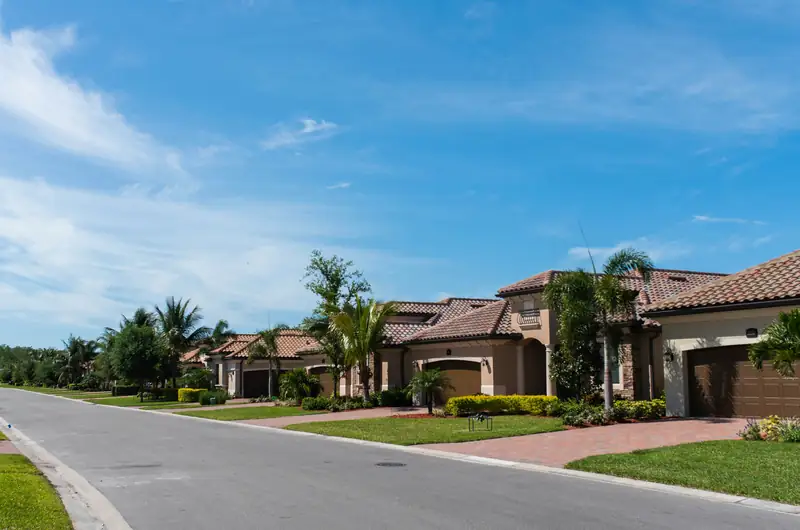
Paver Driveways · Orlando, FL
Paver Driveways in Orlando: Permits, Easements and Coverage Limits
A paver driveway in Orlando runs $10–$30 per sq ft installed as of October 2026, roughly double the plain concrete range because of material and labor. Unlike unincorporated Orange County, which only asks for a zoning permit on residential pavers, the city reviews a paver driveway under the same engineering permit as poured concrete, and any paver work that extends into the right-of-way needs its own memorandum of understanding with the city.
By the Opera Concrete & Pavers estimating team · Updated October 1, 2026
Get a free estimate
Tell us about the project and we'll call to set up a free site visit.
A two-car paver driveway near Lake Nona, worked out in square feet
Say a two-car paver driveway near Lake Nona measures 24 by 24 feet, 576 square feet. At $10–$30 per sq ft installed, that job falls between roughly $5,760 and $17,280 depending on the paver material and base thickness, before any City Paver's MOU paperwork for the right-of-way portion is factored in. If the home sits inside Laureate Park, the Master Association's Architectural Review Board still has to clear the paver color and layout by email before the city permit is submitted, a step that doesn't apply outside that community.
A paver driveway in the right-of-way needs its own MOU
Brick or concrete pavers are allowed in the apron if they meet the manual's paver section, but the sidewalk portion crossing the driveway still has to be at least 3,000 psi concrete, 6 inches thick, and any paver driveway reaching into the right-of-way needs a City Paver's Memorandum of Understanding on file (City of Orlando, Engineering Standards Manual §8.11). New driveways have to be paved at least 15 feet into the property from that apron line (Engineering Standards Manual). That's a heavier review than unincorporated Orange County runs for the same material: there, a residential paver installation needs a zoning permit and a $38 fee rather than a full engineering submission (Orange County, Residential Pavers).
60 mm or 80 mm: picking paver thickness for a driveway
Pavers come in two standard thicknesses for the jobs a homeowner deals with. A 2⅜-inch (60 mm) unit is the standard spec for pedestrian areas and residential driveways under normal car traffic, while a 3⅛-inch (80 mm) unit is reserved for heavier loads, like streets, industrial pavement, or a driveway that regularly carries something bigger than a sedan. The two aren't interchangeable just because they look similar from the sidewalk: the thicker unit spreads load over a larger area and resists point loading better, which matters every time a tire turns in the same spot. For a typical Orlando two-car driveway, 60 mm pavers on a properly compacted base is the standard choice; the 80 mm jump is a conversation for anyone with heavier equipment.
The front-yard coverage cap, read from the 2022 draft ordinance
Orlando's 2022 parking-code amendments, as drafted, set the impervious-surface ratio of the required front or street-side yard at no more than 40 percent for any driveway, parking area or turnaround, with the driveway itself 7 to 18 feet wide at the property line and no wider than 20 feet through the front setback (City of Orlando, Ordinance 2022-45). The outside edge has to sit at least 4 feet from the side line where it meets the right-of-way and at least 2 feet elsewhere, and hammerhead turnarounds aren't allowed on Local Streets. That cap applies to a paver driveway the same way it applies to plain concrete, which is one reason a wider three-car layout sometimes needs a design revision before the permit clears. Confirm the current codified figure with Permitting Services before finalizing a layout.
Why 6 inches of base isn't automatic under a driveway near Orlando
ICPI's own spec sets a residential driveway base at a minimum of 6 inches of compacted aggregate over well-drained soil, while a patio or walkway only needs about 4 inches. That minimum isn't the end of the math: on wet or poorly drained ground, the same spec calls for 2 to 4 inches more before the base is considered done. Around Orlando, which number applies depends on what's actually under the topsoil, not on habit. A crew that quotes 6 inches for every lot skipped the step where someone checks the soil, and that's the step that keeps a driveway from settling at the edges a year later.
Efflorescence: the white haze that isn't a defect
A whitish, powdery bloom can appear on new concrete pavers within about 60 days of installation, and ICPI's own spec is direct about what it is: a calcium carbonate deposit that does not affect the structural performance or durability of the pavers. It can look alarming on a dark paver especially, and a driveway installed during a dry stretch near Orlando may not show it at all until the first real rain of the wet season brings it out. It usually fades with weather and traffic over time and isn't something a sealer is required to fix. Mistaking it for a flaw in the material, rather than a normal early-life process, is the most common false alarm on a new paver driveway.
The order a paver driveway actually goes in
The sequence doesn't vary much from job to job: excavate to the planned depth, compact the subgrade, place and compact the aggregate base in lifts, screed the bedding sand, lay the pavers course by course, cut units at the borders, install edge restraint, then sweep in and compact the joint sand. Each step depends on the one before it holding up, which is why a Orlando crew that rushes the base to reach the visually satisfying part, laying pavers, usually pays for it later in an uneven field. Nothing about the order is optional, even though only the last two steps are visible once the driveway is done and swept clean.
Resweeping joint sand after a pressure wash
A pressure washer aimed straight down into the joints of a paver driveway does what rain does in miniature: it can blast loose joint sand out from between the units, especially where the sand was never stabilized with a sealer or a polymeric additive. ICPI's spec treats that stabilizer as optional, which means plenty of Orlando driveways run on plain dry sand that needs resweeping after a thorough cleaning, not just an occasional touch-up. Washing at an angle rather than straight down, and keeping the pressure moderate near the joints specifically, slows how often that resweep is needed, but it doesn't eliminate the job on a surface built with the standard, unstabilized joint.
Frequently asked questions
Is a paver driveway permitted differently from concrete in Orlando?
Not really: the city reviews pavers under the same engineering permit it uses for poured concrete, unlike unincorporated Orange County, which only requires a lighter zoning permit for residential pavers. The paver driveway also needs a separate memorandum of understanding if it extends into the right-of-way apron.
What is the City Paver's Memorandum of Understanding?
It's a document the city requires on file before a paver driveway crosses into the right-of-way apron, on top of the engineering permit itself. The sidewalk section running through the driveway still has to be poured concrete at the manual's minimum thickness and strength, even when pavers cover the rest.
Does the 40 percent front-yard coverage limit apply to pavers?
Yes, the 2022 parking-code draft treats any driveway, parking pad or turnaround the same regardless of material, counting it toward the front or street-side yard's impervious-surface ratio. A wider paver layout sometimes needs narrowing or a landscaped island to stay under that cap.
Sources
- Census Bureau PEP, City and Town Population Totals, Vintage 2025 (July 1, 2025)
- Census Reporter, Orlando FL (ACS 2020-2024 5-yr, B25035)
- City of Orlando — Apply for an Engineering Permit
- City of Orlando — Engineering Standards Manual, 5th ed.
- City of Orlando — Ordinance 2022-45 Parking Code Amendments
- City of Orlando — Residential Permitting Requirements
- City of Orlando — Apply for a Right-of-Way Permit
- City of Orlando — HB803 Residential Building Permit Exemption Guide
- City of Orlando, Baldwin Park/NTC Main Base: A Brief History
- Baldwin Park Network, Residential Owners Association / ARC
- Baldwin Park Residential Guidelines (Updated 2024)
- Lake Nona, About
- Laureate Park Master Association FAQ
- City of Orlando Ordinance 2020-13 (Tree Preservation, Ch. 60 Part 2B)
- USGS WRI 03-4257, Hydrogeology and Quality of Ground Water in Orange County, Florida
- Florida Senate Interim Report 2011-104 (sinkhole insurance)
- NRCS OSD Myakka
- NRCS OSD Smyrna
- SJRWMD Watering Restrictions
- Orange County — Do I Need a Permit
- Orange County — Residential Pavers
- Orange County — A Guide for Residential Plan Approval
- F.S. 720.3045 (2026) Installation, display, and storage of items
- Florida Statutes §125.572 — synthetic turf on single-family lots
- Florida Administrative Code — Rule 62-308.100, Synthetic Turf (effective May 19, 2026)
- City of Orlando — Historic Preservation Districts
- Wikipedia, Lake Adair–Lake Concord Historic District
Ready for a price on your project?
Request a free estimate
Tell us about the project and we'll call to set up a free site visit.