
Why Do Pavers Sink in Florida, and How Is It Fixed?
Pavers sink in Florida when the compacted base underneath loses material, usually because the base was built to a well-drained spec, about 6 inches, on soil that holds a seasonal water table within 18 inches of the surface instead. As of October 2026, the fix is a releveling job on the affected pavers, not a full rebuild, unless the whole field has settled unevenly across a wide area.
By the Opera Concrete & Pavers estimating team · Updated October 1, 2026
Why Are My Pavers Sinking?
A paver that sinks has almost always lost support from below, not above: fine material in the compacted base has migrated out through the joints or an unsealed edge, leaving a void the paver eventually settles into under its own weight and foot or car traffic. It's rarely the paver itself failing, since a concrete, travertine or porcelain unit is far harder than the sand and aggregate holding it up. Paver driveways and paver patios are both built on a compacted aggregate base specifically to resist this; our paver sealing and restoration service is the page for fixing a section once it's already happened.
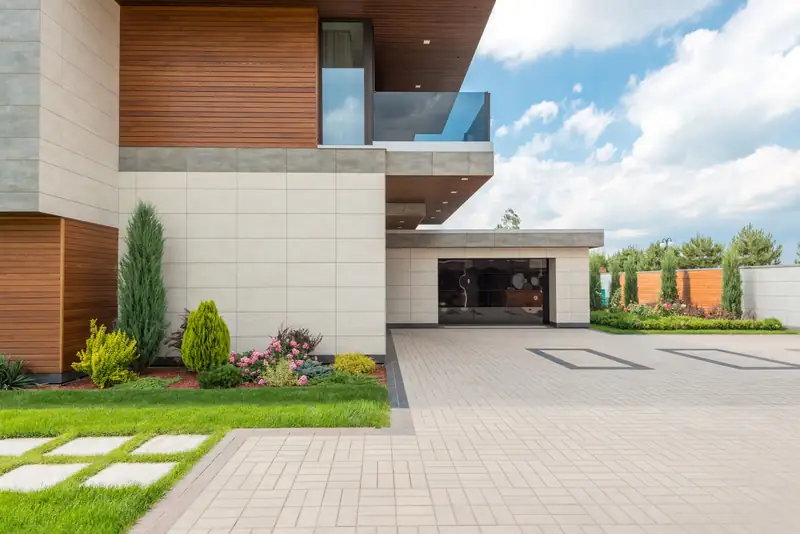
How Does the Base Actually Fail?
A paver field stands on a compacted aggregate base and a thin, uncompacted bedding-sand layer, both doing specific jobs the surface units never do on their own. The industry's own construction standard sets that base at roughly 6 inches on well-drained soil for a residential driveway, but calls for 2 to 4 inches more on wet or weak soil, since the same compaction effort doesn't hold up as well once the ground underneath stays damp for part of the year (ICPI Tech Spec 2). A base built to the well-drained spec on ground that doesn't actually drain well is thinner than the soil condition calls for from the start, which is one straightforward way a paver field starts sinking well before it should.
Why Does Sandy Florida Soil Make This Worse?
Myakka, Smyrna and the other flatwoods soils that dominate both service areas keep groundwater close to grade for stretches of most years; NRCS puts Myakka's seasonal high mark at roughly a foot and a half below the surface (NRCS, Myakka series). Once the water rises that close to a compacted paver base, it can push fine particles upward through the joints from underneath, a different mechanism than ordinary surface water washing sand out in a storm, and one that keeps working even on a surface that looks fine from above. Ridge sands farther inland, Candler and Astatula among them, drain fast enough that this particular failure mode is far less common there, though loose, excessively drained sand brings its own compaction challenges during the original installation. Either way, the soil under a paver field does more to decide how often it needs attention than the paver material on top of it does.
Why Do Pavers Near a Pool Sink More Than the Rest of the Patio?
The section closest to the water usually takes more moisture than anywhere else on the same patio: splash-out, backwash discharge and a pool deck's own slope toward drains all concentrate extra water right at the coping and the first few courses of pavers beyond it, on top of whatever the rainy season already delivers. Our pool deck pavers page covers how the base and drainage plan around a pool differ from an ordinary patio for exactly this reason. A localized low spot that's only around the pool, rather than across the whole patio, usually points to that extra water load rather than a base problem shared by the entire surface.
Edge Restraint: The Part That Fails Quietly
Every paver field needs a restraint running along its perimeter and anywhere the material changes, since without one the outermost pavers have nothing holding the base from spreading sideways under traffic. The industry spec is specific that restraint spikes anchor into the compacted aggregate base itself, not into the surrounding soil, and that landscape edging meant for a planting bed doesn't count as a real restraint system (ICPI Tech Spec 3). A perimeter that was installed with the wrong kind of edging, or none at all, lets the whole field creep outward a little at a time, and the sinking that shows up months later at the driveway's edge or a patio's border traces straight back to that missing step rather than anything wrong with the pavers themselves.
Is a Sinking Paver Field a Sign of a Sinkhole?
In the overwhelming majority of cases, no. A localized low spot over a few square feet of paver field is a base or drainage issue working on a scale of inches, not the sudden, structural event Florida law defines a true sinkhole by. Homeowners in Central Florida ask about this more often than those in Sarasota or Manatee, and our guide to sinkholes vs. normal settlement walks through how the two get told apart before anyone calls a geologist instead of a paving contractor.
Say You Have a 20x20 Paver Patio With One Low Corner
A single corner settling faster than the rest of a patio, rather than the whole field sinking evenly, almost always points to a localized cause right at that corner: a downspout discharging nearby, a low point in the yard's grading that funnels runoff there, or a restraint that let go at exactly that spot. The fix pulls the affected pavers, rebuilds the bedding sand underneath to its original depth, and resets them flush with the rest of the field, which is a smaller, cheaper job than it sounds like as long as it's caught before several more pavers follow the same low corner down.
What Fixing a Sunken Paver Field Involves
Paver repair and releveling runs by scope rather than a flat per-square-foot number, since a single corner costs far less to correct than a field that's sunk across a wide area. Published Florida and national pricing puts paver repair work in the range of roughly $4 to $30 per square foot depending on the extent and location, a wide spread that mostly comes down to how much of the surface needs to come up and go back (Angi, Outdoor Life Pros, Cape Coral). Those figures are general market data current this October, not a number for any one patio; the paver sealing cost guide breaks the range down further by job size and condition.
Frequently asked questions
Do pavers sink more than a poured concrete driveway in Florida?
They fail differently rather than more often. A poured slab is one rigid piece, so a void underneath shows up as a crack or a dropped panel; a paver field is made of individual units, so the same kind of base problem shows up as a gradual low spot instead, often easier to spot early and cheaper to correct since only the affected units need to come up. Our pavers vs. concrete driveway comparison covers the trade-off in more depth.
How soon after installation can pavers start sinking?
There's no fixed timeline, since it depends entirely on whether the original base was compacted to spec for the soil it sits on. A field built to the right thickness for wet or weak ground can go years without a low spot; one built to a well-drained spec on ground that doesn't actually drain well can show a problem within the first rainy season.
Can I fix a sinking paver myself?
Pulling and resetting a handful of pavers is within reach for a confident DIYer with the right hand tools, but getting the bedding sand back to its correct, uncompacted depth and the surface truly flush with its neighbors is where most DIY attempts fall short. A larger or recurring low spot is worth a professional releveling visit rather than repeated patching.
Does a sunken driveway or patio always need a full rebuild?
No. A localized low spot is usually a releveling job limited to the affected pavers, not a full tear-out of the surface. A field that's sunk broadly across most of its area, rather than in one or two spots, is the case where rebuilding the base under the whole surface actually makes more sense than repeated spot repairs.