
How Pavers, Concrete and Pool Decks Hold Up to Florida Hurricanes and Flooding
Properly built concrete slabs rarely fail outright in a hurricane, while interlocking pavers can shift or lose joint sand where storm surge or sheet flooding scours bedding material out from underneath or between the units. As of October 2026, what usually needs attention after a Florida storm is re-sanding joints, resetting a few shifted pavers, or clearing silt from drainage paths, not a full tear-out, provided the base and edge restraint were sound to begin with.
By the Opera Concrete & Pavers estimating team · Updated October 1, 2026
Will Pavers Float or Wash Away in a Hurricane or Flood?
Individual pavers are too heavy to float, but fast-moving storm surge or sheet flooding can scour the sand and aggregate bedding out from under and between them, which lets units shift, sink unevenly or pop loose where an edge isn't well restrained. A properly built paver driveway or paver pool deck uses a concrete curb or anchored edge restraint specifically to keep the field from spreading under ordinary traffic and seasonal ground movement, but storm surge and fast-moving floodwater put a different, more severe kind of force on a base than daily use does, and no edge restraint is rated against that scale of event.
How Does Storm Surge or Heavy Rain Affect a Paver Base?
Rain soaking straight down into an open-graded gravel base generally drains well and isn't the main concern; moving water is. Surge or overland flooding that flows across a yard, rather than simply falling onto it, can carry fine material out of a compacted aggregate base the same way flowing water erodes a streambank, which gradually undermines support even where the pavers themselves look fine right after the storm.
Coastal Sarasota and Manatee properties near the water, on Longboat Key, Siesta Key or Anna Maria Island for instance, sit closer to the kind of wave action FEMA designates Zone VE, a coastal high-hazard area, versus Zone AE, which carries at least a 1 percent annual flood chance but with lower wave heights under FEMA's coastal flood zone definitions. A property's actual flood zone is looked up by address at FEMA's Flood Map Service Center at msc.fema.gov.
How Does a Concrete Driveway or Patio Hold Up to a Hurricane?
A monolithic concrete slab doesn't shift the way loose units can, since it's one continuous piece rather than thousands of individual stones, but that doesn't make it immune. Standing floodwater sitting against or under a slab for an extended period can erode the subgrade at an edge or where the slab meets bare soil, which shows up as settlement weeks or months later rather than as visible damage during the storm itself. Wind-driven debris can also chip or crack an exposed edge or corner.
What Does Florida Building Code Account for in Hurricane-Prone Areas?
Florida's code defines a wind-borne debris region within hurricane-prone areas, generally within a mile of the coast where design wind speeds reach 130 mph, or anywhere the design wind speed reaches 140 mph, which drives stricter requirements for things like impact-resistant glazing on the building itself under the Florida Building Code's wind-loads guidance. Exterior flatwork isn't engineered to the same standard as the structure, which is part of why a driveway or pool deck in a high-wind coastal zone can still take on debris damage or surge-related base erosion even when the house next to it weathers the storm with no structural issues.
What Should You Check on Pavers and Concrete After a Storm?
Most post-storm issues are fixable without a full tear-out, provided the base was sound to begin with; the exception is where water sat for days against an edge with nowhere to drain.
- Look for rocking or sunken pavers. A paver that shifts underfoot or sits noticeably lower than its neighbors is a sign the base under it washed out and needs to be reset, not just cleaned.
- Check joint sand levels. Storm rain and surge both strip joint sand; low or missing sand between pavers is common and gets topped off as part of routine paver sealing and restoration.
- Inspect concrete for new cracks. A crack that wasn't there before the storm, especially near an edge that was under water, is worth noting even if it looks minor at first.
- Clear drainage paths. Swales, French drains and yard grading that moved silt or debris during the storm need to be cleared so the next heavy rain drains the way it's supposed to.
- Let a saturated base dry before repairing. Re-leveling pavers or patching concrete over a still-wet, soft base rarely holds; waiting for the ground to firm up first saves a repeat repair later.
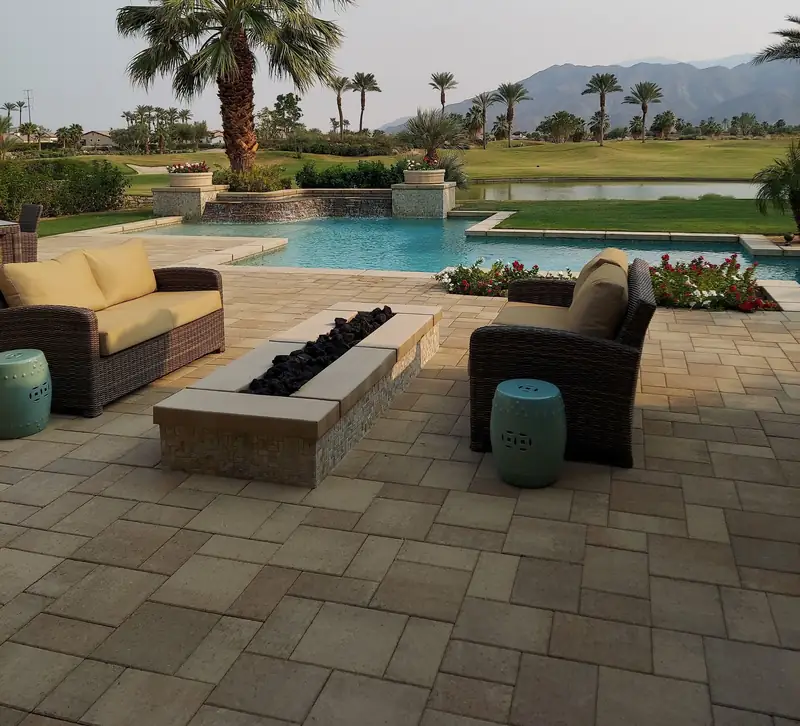
Say a lanai's paver pool deck comes through a tropical storm with several feet of standing water against one side for most of a day: the pavers themselves may look unchanged once the water recedes, but the base under that edge is the part worth checking first, since that's where sustained, moving water does its damage even when nothing looks wrong on the surface. A pool deck re-leveled too early, before the base has actually dried and firmed back up, is the kind of repair that needs doing twice.
Frequently asked questions
Do I need to remove pavers before a hurricane?
No, that isn't standard practice for an existing, properly installed paver surface. The bigger pre-storm priorities are the usual hurricane prep around the house itself and clearing drains and swales so water has somewhere to go once the rain starts.
Can a cracked concrete slab be repaired after a storm, or does it need replacing?
It depends on the crack and what's under it. A surface crack from debris impact is often a repair; a crack that keeps widening because the base under it washed out usually isn't. Our resurface-vs-replace comparison walks through how that call typically gets made.
Will silt or mud from flooding ruin pavers or concrete?
Usually not permanently. A pressure wash once the area has dried out, followed by checking and topping off joint sand on pavers, handles most flood-related staining and residue. Our guide to cleaning pavers without damage covers the method in more detail.
Are paver pool decks more at risk in a storm than concrete pool decks?
They carry a different kind of risk rather than a bigger one. A paver pool deck can show individual units shifting or losing joint sand first, since those parts can move independently, while a concrete deck that cracks usually presents as one decision about repair or replacement rather than several small spot fixes.
Should I expect more storm damage on a waterfront lot in Sarasota or Manatee County?
A property closer to open water, a canal or the Gulf faces more direct wave and surge energy than one farther inland, which is reflected in FEMA's coastal flood zone mapping for the area. That doesn't change how pavers or concrete are built, but it does mean checking the base and any edge restraint after a storm is worth doing sooner on a waterfront lot than on one well back from the water.