
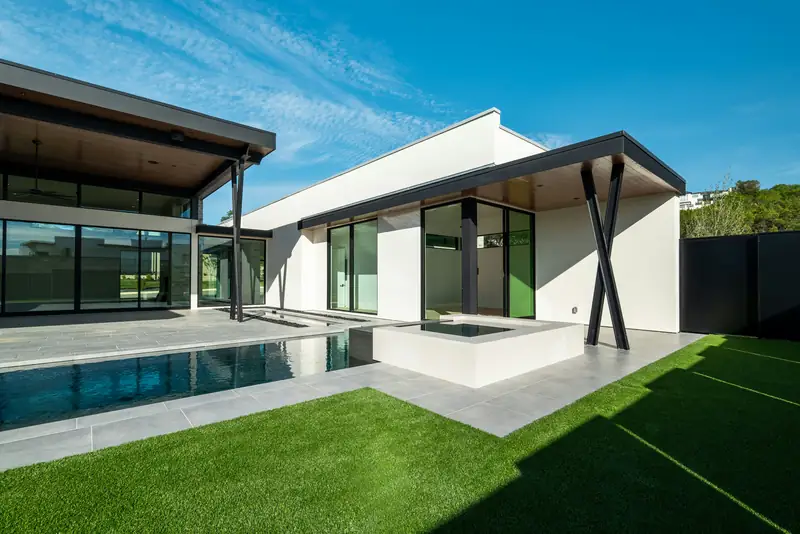
Artificial Turf · Sarasota, FL
Artificial Turf Installation in Sarasota
Artificial turf in Sarasota runs $10–$25 per sq ft installed as of October 2026. It sits outside the city's current once-a-week watering order once installed, and the state's own turf rule steers installation around protected tree root zones the same way the city's arborist process already does.
By the Opera Concrete & Pavers estimating team · Updated October 1, 2026
Get a free estimate
Tell us about the project and we'll call to set up a free site visit.
How the state turf rule and the city's tree rule line up
Florida Administrative Code Rule 62-308.100, effective May 19, 2026, sets the statewide installation standard for synthetic turf: natural infill, a washed base, a 10-foot setback from any waterbody without a seawall, no in-ground irrigation beneath it, and turf kept clear of a tree's canopy edge unless a licensed arborist approves a closer install Florida Administrative Code — Rule 62-308.100, Synthetic Turf (effective May 19, 2026). That last piece lines up with a rule Sarasota already runs on its own: root pruning near a protected tree has to be finished and inspected by the city arborist before building-permit inspections proceed, and a Grand Tree, a live oak 24 inches across or wider, carries its own 20-foot barricade distance City of Sarasota, Tree Protection. On a lot with mature canopy, one arborist visit tends to cover both requirements rather than two separate approvals.
Watering restrictions turf doesn't have to live with
Lawn irrigation in Sarasota is down to one watering day a week, assigned by address, under SWFWMD's Modified Phase III shortage order, a schedule the city confirmed runs through March 2027 SWFWMD District Water Restrictions City of Sarasota - SWFWMD Modified Phase III extended. A sod lawn has to live inside that calendar until it lifts; turf, once installed and rinsed in, needs no irrigation afterward at all. The law's protection for turf against an HOA has a limit, too: under F.S. §720.3045, it only shields turf hidden from the street and from neighboring lots, nothing visible from either, so a front-yard install in a deed-restricted community is worth checking against the association's own rules first.
What goes under artificial turf on Florida soil
Florida's new turf rule treats the base as part of the system, not an afterthought. DEP Rule 62-308.100 requires the subgrade under residential turf to be washed crushed rock or crushed concrete, never limerock or road base with fines, because fines bind together and seal the soil the way a driveway base is supposed to. Most lots around Sarasota sit on sandy flatwoods soils with a seasonal high water table that can sit within two feet of the surface for part of the year. A compacted aggregate lift that still drains is the only way to keep the lawn from holding water under the turf after a summer storm rolls through.
Why an arborist visit can come before the install crew does
If turf is planned inside a live oak's drip line, the arborist certification required by DEP Rule 62-308.100 has to happen before any grading starts, not as a step folded into the install. Once that certification is in hand, the crew works the root zone by hand, digging and placing base material in small sections instead of trenching or running equipment across roots. On a Sarasota property with a mature oak close to the planned turf area, this adds a scheduling step up front, but it keeps the install from running into a stop-work problem halfway through a yard that's already been opened up.
Say you have a 400 sq ft side yard, currently struggling sod under a live oak canopy, going to artificial turf for a dog run
Say you have a 400 sq ft side yard, currently struggling sod under a live oak canopy, going to artificial turf for a dog run. At the market range of $10–$25 per sq ft, that runs $4,000 to $10,000, or roughly $4,800 to $7,200 in the typical $12–$18 band for a washed-rock base and pet-rated infill. Because the yard sits under the oak's drip line, DEP Rule 62-308.100 calls for an arborist's sign-off before installation, the same inspection the city's own root-pruning rule would require if the project disturbed the tree's roots instead. Once installed, the turf comes off SWFWMD's once-a-week watering schedule entirely, which is most of the appeal on a shaded side yard where sod was already struggling under the canopy.
Why in-ground sprinkler heads can't stay live under turf
DEP Rule 62-308.100 says in-ground irrigation can't be used to water a synthetic turf area, and a local government may require existing heads in that zone to be removed and the pipe capped below grade. Leaving a head live under turf doesn't just risk a rule violation, a buried, pressurized head eventually finds a seam or a low spot and pushes water up through it. The build spec calls for capping the lateral line and plugging the head location before the base goes in, not patching around a head that's still connected. On a Sarasota job, that irrigation zone is then either abandoned or redirected to beds and sod that still need it.
Why compacting the base too hard can be its own mistake
The instinct on a sandy Sarasota lot is to compact the base as hard as it'll go, since a firm surface feels like a better foundation for turf. Florida's turf rule caps that instinct: the subgrade can't be compacted tight enough to stop water percolating through it, and a local government may set a specific maximum permeability standard the installed system has to meet. A base compacted past that point behaves almost like the fines problem, water that should move through the soil instead collects at the surface, under the turf, where nobody sees it until the yard starts smelling or feeling spongy underfoot.
Why weeds show up at turf seams and edges first
Seeds blow in and settle at a seam or a perimeter edge before they settle in the middle of an open panel, since that's where wind-blown debris and a little extra soil tend to collect over time on a Sarasota lawn. Pulling a stray weed at a seam while it's small keeps its roots from working into the backing or lifting an edge as it grows. A board or a stiff brush dragged along the perimeter during a regular debris pass usually catches this before it needs a dedicated trip, since it's the same edges that get checked after storms anyway.
Frequently asked questions
Does artificial turf under a live oak in Sarasota need special approval?
Yes. State Rule 62-308.100 keeps turf off a tree's canopy edge unless a licensed arborist signs off on a closer layout, which lines up with the city's own root-pruning and arborist-inspection rule for work near protected trees.
Can my Sarasota HOA ban artificial turf in the front yard?
Only partly. F.S. §720.3045 shields turf an HOA can't see from the street or from a neighboring lot; anything visible from either still depends on that association's own design rules.
Does turf help with Sarasota's current watering restrictions?
Once installed, yes. SWFWMD's current shortage order holds sod to one watering day a week into 2027, and turf, once it's watered in during installation, is free of that calendar for good.
Sources
- City of Sarasota Code §29.5-7 Curb cuts and driveways
- City of Sarasota Code §29.5-8 Erosion and siltation control permits
- City of Sarasota Public Works — Engineering (ROW permits)
- City of Sarasota Building Permit Requirement Guidelines
- City of Sarasota Zoning Code §VI-203 (Table VI-203)
- City of Sarasota Zoning Code §VI-907 Coastal Islands Overlay
- City of Sarasota permitting portal
- City of Sarasota, Tree Protection
- City of Sarasota - SWFWMD Modified Phase III extended
- Census Reporter, Sarasota FL (ACS 2020-2024 5-yr, B25035)
- Census Bureau PEP, City and Town Population Totals, Vintage 2025 (July 1, 2025)
- FDOT Structures Design Guidelines Vol. 1, §1.3.2 environmental classification
- FEMA - Features of Flood Insurance Rate Maps in Coastal Areas
- FDEP Coastal Construction Control Line Program
- FDEP — Apply for a CCCL permit
- SWFWMD District Water Restrictions
- Florida Administrative Code — Rule 62-308.100, Synthetic Turf (effective May 19, 2026)
- Florida Statutes §125.572 — synthetic turf on single-family lots
- NRCS OSD EauGallie
- NRCS OSD Immokalee
- Laurel Park Historic District, National Register of Historic Places (listed March 11, 2008)
- City of Sarasota tree protection ordinance — root-pruning, barricades and arborist inspection (Div. 3.1)
Ready for a price on your project?
Request a free estimate
Tell us about the project and we'll call to set up a free site visit.