
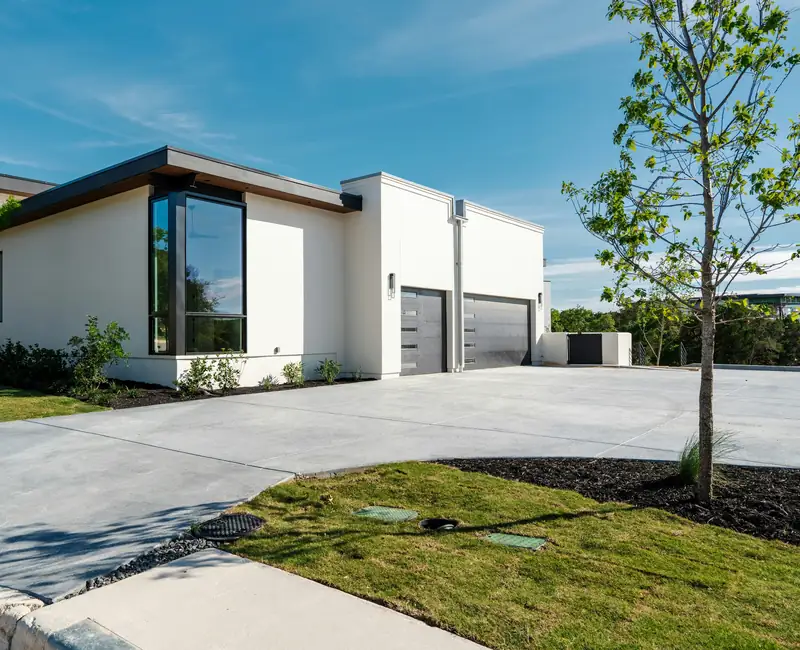
Concrete Driveways · Sarasota, FL
Concrete Driveway Installation in Sarasota
A new or replacement concrete driveway in Sarasota runs $6–$15 per sq ft installed as of October 2026, before the part that touches the right-of-way, which the city engineer permits separately under Sec. 29.5-7. Lots here sit on EauGallie or Immokalee flatwoods soil, with a seasonal water table within 18 inches of the surface, which shapes how the base and swale get built.
By the Opera Concrete & Pavers estimating team · Updated October 1, 2026
Get a free estimate
Tell us about the project and we'll call to set up a free site visit.
Why the apron is a separate permit from the rest of the slab
Sec. 29.5-7 draws a hard line at the property edge: it is unlawful to cut a curb or build a driveway in the public right-of-way without a permit from the city engineer, built to the Engineering Design Criteria Manual, with a fee the city sets under a separate ordinance City of Sarasota Code §29.5-7. The Engineering Division that issues it covers the right-of-way broadly, streets, alleys, parkways, sidewalks and drainage, out of 1575 2nd St, (941) 263-6793 or ROWerosion@sarasotafl.gov, Monday through Friday 7:30 to 4:30 City of Sarasota Public Works — Engineering (ROW permits). Applications go in online through the city's permitting portal ftgportal.sarasotafl.gov. The slab between the sidewalk and the garage is a separate question; the city's own Building Permit Requirement Guidelines don't name driveways on the exempt list, so when the scope is unclear we call the Building Division at (941) 263-6494 before pricing the job City of Sarasota Building Permit Requirement Guidelines.
What flatwoods soil does to the base under the slab
Most Sarasota lots sit on EauGallie or Immokalee fine sand, both poorly drained flatwoods soils with a seasonal high water table within about 6 to 18 inches of the surface for part of the year NRCS OSD EauGallie NRCS OSD Immokalee. Florida's residential code limits clean sand or gravel fill under a slab to 24 inches and earth fill to 8 inches unless an engineer approves otherwise, and calls for at least 4 inches of compacted base beneath it. On a driveway headed for a boat trailer or a dual-axle work truck, we go beyond the 3½-inch code minimum and thicken the section rather than lean on the base alone to carry the extra load, since a wet subgrade gives a slab less to work with than a well-drained ridge lot would.
What a Flatwoods Lot Means for the Subgrade
Much of Greater Orlando and the Suncoast sits on flatwoods soil series like Myakka, Smyrna, Immokalee, EauGallie and Pomona, which hold a water table within 18 inches of the surface for one to four months most years. That is workable ground for a driveway, but only if we test it before pouring instead of assuming it behaves like the lot next door. Wet, weak native soil will not compact to a stable subgrade no matter how long a plate compactor runs over it. On a Sarasota property with this kind of soil, we remove the saturated layer and build up with compacted fill rather than forming directly on soggy ground, which is what keeps the slab from settling unevenly within a few years.
What a Permit Inspection Actually Checks Before the Pour
Where Sarasota or the county requires a permit for the work, an inspector typically looks at the job before concrete gets poured, not after, checking things like form layout, base material and any reinforcement going in. That review happens at the forming stage, which is one more reason forming and base work take real time rather than getting rushed. A failed or delayed inspection pushes the pour date back, so we schedule the inspection early in the process to protect the rest of the timeline. Jurisdictions differ in exactly what gets checked, so confirming the local process before we mobilize avoids a surprise delay.
Say you have an 18 × 50 ft driveway, 900 sq ft, in one of Sarasota's 1970s-built subdivisions where the original slab has settled unevenly near the street
Say you have an 18 × 50 ft driveway, 900 sq ft, in one of Sarasota's 1970s-built subdivisions where the original slab has settled unevenly near the street. At the market range of $6–$15 per sq ft, a full tear-out and repour lands between $5,400 and $13,500, and within the typical $8–$12 band that narrows to roughly $7,200 to $10,800. That figure covers only the private portion; the apron in the right-of-way needs its own Sec. 29.5-7 permit from the city engineer, and if the old slab's edge sits closer to a live oak than the city's root-pruning barricade distance, the arborist inspection has to clear before the pour can be scheduled. A written quote follows a site visit, since the swale grade and the condition of the existing base change the number.
Choosing a Finish Before the Truck Shows Up
A broom finish is the plain, standard surface most driveways get: a broom is dragged across the concrete while it is still workable, leaving a texture that sheds water and resists slipping. Exposed aggregate goes a step further, washing or blasting the surface cement off so the stone inside the mix shows through, which changes both the look and the grip underfoot. Both sit within the basic tier of finish work, well short of stamped or multi-color decorative treatments. The choice has to be made before the pour starts in Sarasota, since a broom finish cannot become exposed aggregate after the fact without resurfacing.
Sprinkling Water on a Slab to Finish It Faster Backfires
When concrete starts to stiffen before finishing is done, sprinkling water on the surface is a tempting shortcut and a documented bad one: hot-weather guidance specifically warns against it, because it weakens the top layer of the slab exactly where it needs to be strongest. The same caution applies to adding extra water to a load that is already more than an hour and a half old just to make it easier to work. On a hot Sarasota pour, we manage the pace of the work itself rather than fix a stiffening slab with a hose, since the surface that results from sprinkling is softer and less durable than it looks.
Pressure Washing Without Driving the Sand Out of the Joints
Pressure washing is a normal part of keeping a driveway's finish looking like it did on pour day, and sizing the job is straightforward: a single-car driveway runs roughly 200 to 400 square feet, a two-car 400 to 700, and anything larger climbs from there. What is easy to overlook on a Sarasota driveway is that a wand aimed straight down a control joint can blast out sand or stabilizer that was doing a job, leaving the joint more open to weeds and debris than it was before. Angling the spray across the joint rather than into it keeps the cleaning from undoing maintenance that was already done.
Frequently asked questions
Does a straight driveway replacement in Sarasota need a city permit?
The portion in the right-of-way does, under Sec. 29.5-7, issued by the city engineer through the Engineering Division. The private portion between the sidewalk and the garage falls into a gap the city's own guidelines don't name directly, so we confirm with the Building Division before starting.
Why does the water table in Sarasota matter for a driveway base?
EauGallie and Immokalee, the two soils most common under Sarasota driveways, run poorly drained with a shallow seasonal high water table for part of the year. A wet subgrade compacts differently than dry ridge sand, which is one reason we don't treat every lot's base the same way.
Can I widen my driveway past the current apron in Sarasota?
Widening crosses back into right-of-way territory, so it needs the same Sec. 29.5-7 permit as a new driveway, plus a check against the lot's impervious coverage cap under Table VI-203 before the city engineer signs off.
Sources
- City of Sarasota Code §29.5-7 Curb cuts and driveways
- City of Sarasota Code §29.5-8 Erosion and siltation control permits
- City of Sarasota Public Works — Engineering (ROW permits)
- City of Sarasota Building Permit Requirement Guidelines
- City of Sarasota Zoning Code §VI-203 (Table VI-203)
- City of Sarasota Zoning Code §VI-907 Coastal Islands Overlay
- City of Sarasota permitting portal
- City of Sarasota, Tree Protection
- City of Sarasota - SWFWMD Modified Phase III extended
- Census Reporter, Sarasota FL (ACS 2020-2024 5-yr, B25035)
- Census Bureau PEP, City and Town Population Totals, Vintage 2025 (July 1, 2025)
- FDOT Structures Design Guidelines Vol. 1, §1.3.2 environmental classification
- FEMA - Features of Flood Insurance Rate Maps in Coastal Areas
- FDEP Coastal Construction Control Line Program
- FDEP — Apply for a CCCL permit
- SWFWMD District Water Restrictions
- Florida Administrative Code — Rule 62-308.100, Synthetic Turf (effective May 19, 2026)
- Florida Statutes §125.572 — synthetic turf on single-family lots
- NRCS OSD EauGallie
- NRCS OSD Immokalee
- Laurel Park Historic District, National Register of Historic Places (listed March 11, 2008)
- City of Sarasota tree protection ordinance — root-pruning, barricades and arborist inspection (Div. 3.1)
Ready for a price on your project?
Request a free estimate
Tell us about the project and we'll call to set up a free site visit.