
Pool Deck Pavers · Orlando, FL
Pool Deck Pavers in Orlando: New Decks and Overlays
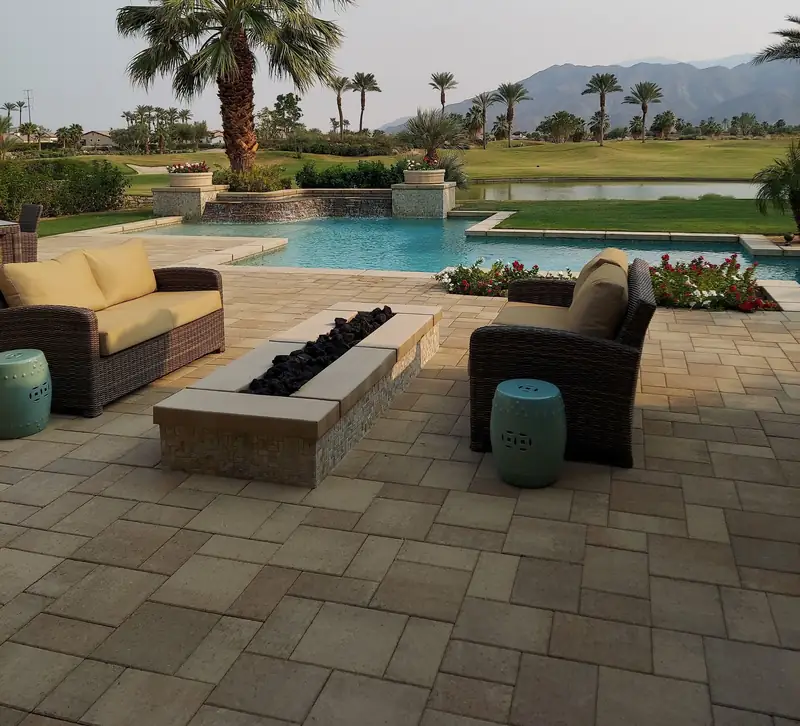
Pool deck pavers in Orlando run $12–$30 per sq ft installed as of October 2026, whether laid over a new slab or set as an overlay on an older deck. With the typical Orlando home dating to 1992, a lot of the original broom-finish and cool-deck pool surfaces around the city are now old enough that a paver overlay is a common alternative to full resurfacing.
By the Opera Concrete & Pavers estimating team · Updated October 1, 2026
Get a free estimate
Tell us about the project and we'll call to set up a free site visit.
A paver overlay on a 1990s-era Orlando pool deck, worked out in square feet
Say a 1990s-built home resurfaces a 600 square foot original cool-deck pool patio with pavers over the existing slab. At $12–$30 per sq ft installed, that overlay lands between roughly $7,200 and $18,000 depending on the paver material, from standard concrete pavers at the lower end to travertine at the upper end. A tear-out and full replacement instead of an overlay adds demolition cost but avoids building on whatever settling the original slab has already done.
Resurfacing a 1990s-era pool deck with pavers still needs a permit
Orlando's median year of home construction is 1992 (Census Reporter, Orlando), old enough that many original concrete pool decks around the city are candidates for a paver overlay rather than a full tear-out. The city's engineering permit covers pavers “whether installing/removing pavers, asphalt, concrete or expanding” an existing paved area, which reaches an overlay laid over an existing slab, not just new construction (City of Orlando, Residential Permitting Requirements). Inside a historic district, a Certificate of Appropriateness applies if the new deck color or coping is visible from a public street (City of Orlando, Historic Preservation Districts).
Paver Thickness for a Pool Deck Matches a Patio, Not a Driveway
ICPI's 60 mm, 2.375-inch standard for pedestrian areas covers a pool deck the same way it covers a patio, since lounge chairs and bare feet don't come close to the load a driveway carries. A Orlando homeowner who's seen 80 mm units quoted for a neighbor's driveway doesn't need that heavier paver around a pool, where the extra thickness adds cost without adding anything the job actually requires. What matters more for a paver deck's long-term feel is a properly compacted base and a tight joint at every edge, including the one against the coping, not a thicker unit sitting on an otherwise ordinary base.
Older pools inland, newer pools near Lake Nona
Because Lake Nona's 17 square miles were planned and built out largely after the rest of the city (Lake Nona, About), most of its pools and decks are recent enough that homeowners there are choosing pavers for a first install rather than resurfacing an aging slab. Closer to the city's older, established neighborhoods, where the typical home is now more than three decades old, the opposite pattern shows up more often: an original deck reaching the point where an overlay, rather than a patch, makes more sense. A new concrete pool deck is the other option at either stage.
Base Depth for a Paver Deck Follows the Patio Spec, Not the Driveway Spec
A paver pool deck carries the same light pedestrian load a patio does, lounge chairs, foot traffic, the occasional umbrella stand, so the ICPI minimum of 4 inches of compacted base on well-drained soil applies here too, not the heavier 6-inch driveway spec. What's different around a pool is how much more moisture the base near the water's edge sees from splash-out, backwash and equipment pad runoff, on top of whatever rain the rest of the yard gets. On a Orlando job, we treat the few feet closest to the coping as wetter ground by default and compact accordingly, even on a lot where the rest of the base tests dry.
A Paver Field That Slopes the Wrong Way Dumps Debris in the Pool
A paver deck graded flat or tilted toward the water instead of toward its drains sends pollen, cut grass and yard debris straight into the pool with every rain, which throws off the chemical balance faster than ordinary splash-out and evaporation would. On a Orlando property, that kind of misgrade usually traces back to a base that was leveled by eye rather than shaped with the pool deck's two-direction slope built in from the start. The pattern often shows up first as an unusually chemical-hungry pool rather than as visibly standing water, since a flat paver field doesn't always look wrong until someone runs a hose across it.
Protecting the Pool While the Old Deck Comes Out
Demolishing an existing paver or concrete deck around a pool that's staying filled means covering the water before the first paver or slab section comes up, since broken material and dust land in the pool far more easily than most homeowners expect. We stage removal in sections working away from the coping rather than breaking out the whole field at once, which keeps the open excavation smaller and easier to keep debris out of at any point in a Orlando job. Pulling coping units last, right before the new base goes in, also protects the bond beam from impact damage during the rest of the demolition.
Rinsing the Coping and Splash Zone More Often Than the Rest of the Deck
The coping and the few feet of paver field closest to the water pick up salt, chlorine residue and sunscreen oils far faster than the rest of the deck, which only sees ordinary rain and dust. A quick hose-down of just that zone a few times a month, separate from whatever cleaning schedule the rest of the Orlando deck gets, keeps those residues from building into staining a mild cleaner can't fully lift later on. This is less upkeep overall than it sounds, since it's a narrow strip of deck rather than the whole field that needs the extra attention.
Frequently asked questions
Can pavers go over an existing cracked pool deck in Orlando?
Often yes, as an overlay, and the city's engineering permit covers that scope the same way it covers a new installation. Whether an overlay or a tear-out makes more sense depends on how much the existing slab has settled or cracked, which is worth checking before committing to either approach.
Is a permit needed for a pool deck paver overlay, or just new construction?
Both. Orlando's engineering permit language covers installing, removing or expanding pavers, asphalt or concrete, which reaches an overlay on an existing deck as well as a brand-new pour.
Are older or newer Orlando homes more likely to need pool deck paver work?
Both, for different reasons. Newer construction around Lake Nona tends toward a first paver install on a new pool, while the city's older, established neighborhoods, where the typical home is now more than 30 years old, see more overlay and resurfacing work on original concrete decks.
Sources
- Census Bureau PEP, City and Town Population Totals, Vintage 2025 (July 1, 2025)
- Census Reporter, Orlando FL (ACS 2020-2024 5-yr, B25035)
- City of Orlando — Apply for an Engineering Permit
- City of Orlando — Engineering Standards Manual, 5th ed.
- City of Orlando — Ordinance 2022-45 Parking Code Amendments
- City of Orlando — Residential Permitting Requirements
- City of Orlando — Apply for a Right-of-Way Permit
- City of Orlando — HB803 Residential Building Permit Exemption Guide
- City of Orlando, Baldwin Park/NTC Main Base: A Brief History
- Baldwin Park Network, Residential Owners Association / ARC
- Baldwin Park Residential Guidelines (Updated 2024)
- Lake Nona, About
- Laureate Park Master Association FAQ
- City of Orlando Ordinance 2020-13 (Tree Preservation, Ch. 60 Part 2B)
- USGS WRI 03-4257, Hydrogeology and Quality of Ground Water in Orange County, Florida
- Florida Senate Interim Report 2011-104 (sinkhole insurance)
- NRCS OSD Myakka
- NRCS OSD Smyrna
- SJRWMD Watering Restrictions
- Orange County — Do I Need a Permit
- Orange County — Residential Pavers
- Orange County — A Guide for Residential Plan Approval
- F.S. 720.3045 (2026) Installation, display, and storage of items
- Florida Statutes §125.572 — synthetic turf on single-family lots
- Florida Administrative Code — Rule 62-308.100, Synthetic Turf (effective May 19, 2026)
- City of Orlando — Historic Preservation Districts
- Wikipedia, Lake Adair–Lake Concord Historic District
Ready for a price on your project?
Request a free estimate
Tell us about the project and we'll call to set up a free site visit.