
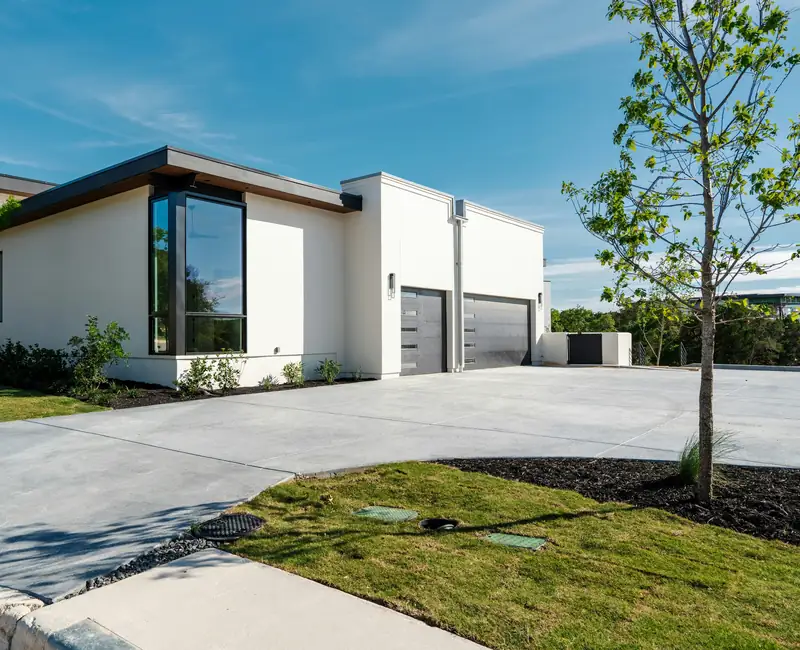
Concrete Driveways · Orlando, FL
Pouring or Replacing a Concrete Driveway in Orlando
A new or replacement concrete driveway in Orlando runs $6–$15 per sq ft installed as of October 2026. Every job, from a straight repour to a widened apron, needs the city's engineering permit rather than a building permit, and the apron itself has to be at least 6 inches of 3,000 psi concrete with a break joint at the property line.
By the Opera Concrete & Pavers estimating team · Updated October 1, 2026
Get a free estimate
Tell us about the project and we'll call to set up a free site visit.
Why this is an engineering permit, not a building permit
The Permitting Services Division reviews driveway work under an engineering permit, the same category covering any work that touches the right-of-way, with Permitting Services reachable at 407-246-2271 (City of Orlando, Apply for an Engineering Permit). The Engineering Standards Manual sets single-family driveway width at 7 to 18 feet measured at the throat, with ribbon driveways built 23 to 36 inches per ribbon and a 28-inch gap between them, and no driveway closer than 3 feet to the property line or within 3 feet of a drainage inlet (City of Orlando, Engineering Standards Manual §8.11). Submitting a permit means a dimensioned survey, MOT notes for any apron work, and a recorded Notice of Commencement if the contract runs past $5,000 (City of Orlando, Residential Permitting Requirements). That's a heavier review than a straight resurfacing of the existing footprint, which is why we confirm scope with the permit desk before quoting a number.
What a Flatwoods Lot Means for the Subgrade
Much of Greater Orlando and the Suncoast sits on flatwoods soil series like Myakka, Smyrna, Immokalee, EauGallie and Pomona, which hold a water table within 18 inches of the surface for one to four months most years. That is workable ground for a driveway, but only if we test it before pouring instead of assuming it behaves like the lot next door. Wet, weak native soil will not compact to a stable subgrade no matter how long a plate compactor runs over it. On a Orlando property with this kind of soil, we remove the saturated layer and build up with compacted fill rather than forming directly on soggy ground, which is what keeps the slab from settling unevenly within a few years.
Baldwin Park's alley-loaded lots keep the first 7 feet in concrete
A lot of Baldwin Park homes load their garage off a rear alley rather than the street, so the driveway rule there works in reverse from a typical apron. The neighborhood's 2024 residential guidelines limit a front driveway to the width of the garage door opening, discourage oversized or circular drives, and, where the alley-side drive is built in brick or concrete pavers, require the first 7 feet measured from the edge of the alley pavement to stay solid concrete (Baldwin Park Residential Guidelines, 2024). The association's Architectural Review Committee signs off on the change at one of its twice-monthly meetings before work starts (Baldwin Park ROA, ARC page). Outside Baldwin Park, a paver driveway skips that particular rule, but the city's own apron spec still applies at the street.
Florida's Minimum Isn't What We Build a Driveway To
Florida's residential code sets 3 1/2 inches as the minimum thickness for a slab on the ground, but that number is written for ordinary floors, not a surface that takes a car's full weight every day. For daily passenger traffic, we build a Orlando driveway a full 4 inches thick, poured at a strength in the 3,000 to 4,000 psi range. The extra half inch over the code minimum is not padding: it gives the slab room to carry point loads, like a jack stand or a trailer tongue, without stressing the edge of what code treats as acceptable. Garage floors and carports fall under the same code section but carry their own strength requirement by weathering exposure.
A Baldwin Park alley driveway, worked out in square feet
Say a Baldwin Park alley-loaded driveway measures 10 by 20 feet, 200 square feet, replacing a cracked original pour. Under the neighborhood's 2024 guideline, the first 7 feet back from the alley pavement, about 70 square feet, has to be poured in solid concrete even if the rest of the driveway later gets pavers. At $6–$15 per sq ft installed for a straight repour, that 200 square foot job lands between $1,200 and $3,000 before an old-slab removal or the apron tie-in is added. A driveway sized for a two-car household, 24 by 24 feet, runs the same per-square-foot range across 576 square feet, roughly $3,456 to $8,640, before the alley-concrete requirement changes the mix of materials on the job.
What Actually Happens Before the Concrete Truck Arrives
Forming and grading come before anything gets poured. We set the forms to the final layout, grade and compact the subgrade, and if Orlando requires a permit for the work, the inspector typically needs to see the forms and base before concrete covers them up. Only after that review, where one applies, do we schedule the truck. Skipping straight to a pour date without this sequence is how a driveway ends up with a base nobody checked, which is the most common point where later problems start. The forming and grading day usually takes longer than the pour itself.
The Cracking That Starts Before the Slab Even Cures
When the evaporation rate from a fresh slab climbs above roughly 0.2 pounds per square foot per hour, which happens on hot, windy, low-humidity days, the surface can dry out faster than the concrete underneath gains strength. The result is plastic shrinkage cracking: thin, usually parallel cracks spaced a few feet apart that show up within hours of finishing. A Orlando pour on a hot, breezy afternoon is exactly the kind of day this happens on, and once those cracks form they cannot be undone, only patched. Windbreaks, fog sprays and a dampened subgrade all reduce the risk, but only when the crew is watching the conditions, not just the clock.
Reading Rainy Season Numbers Before the Storms Start
Orlando averages about 51.45 inches of rain a year and Sarasota-Bradenton about 49.05, most of it concentrated in a rainy season that typically runs from late May into October. Before that season starts, it is worth walking a Orlando driveway and clearing leaves, mulch and sand out of the control joints, since a joint packed with debris cannot channel water the way an open one does. Standing water that collects against a slab edge because a joint is clogged works on the base underneath over an entire wet season, not just one storm, which is a slower version of the same settlement problem poor compaction causes.
Frequently asked questions
Does the City of Orlando require a permit for a concrete driveway?
Yes, an engineering permit covers both the apron in the right-of-way and the driveway on your lot, reviewed by the Permitting Services Division. A straight repour within the existing footprint is a smaller submission than a widened or relocated driveway, so confirm the scope with the permit desk before ordering concrete.
How wide can a single-family driveway be in Orlando?
The Engineering Standards Manual sets 7 to 18 feet at the throat, and a 2022 parking-code update, read from its adoption draft, caps the front or street-side yard's impervious coverage at 40 percent for any driveway, parking pad or turnaround. Confirm the current codified figure with Permitting Services before finalizing a design.
Can I use pavers instead of concrete in a Baldwin Park alley driveway?
Mostly. The 2024 neighborhood guidelines allow brick or concrete pavers for the rest of the driveway, but the first 7 feet back from the alley pavement still has to be solid concrete, and the Architectural Review Committee reviews the plan before the city permit moves forward.
Sources
- Census Bureau PEP, City and Town Population Totals, Vintage 2025 (July 1, 2025)
- Census Reporter, Orlando FL (ACS 2020-2024 5-yr, B25035)
- City of Orlando — Apply for an Engineering Permit
- City of Orlando — Engineering Standards Manual, 5th ed.
- City of Orlando — Ordinance 2022-45 Parking Code Amendments
- City of Orlando — Residential Permitting Requirements
- City of Orlando — Apply for a Right-of-Way Permit
- City of Orlando — HB803 Residential Building Permit Exemption Guide
- City of Orlando, Baldwin Park/NTC Main Base: A Brief History
- Baldwin Park Network, Residential Owners Association / ARC
- Baldwin Park Residential Guidelines (Updated 2024)
- Lake Nona, About
- Laureate Park Master Association FAQ
- City of Orlando Ordinance 2020-13 (Tree Preservation, Ch. 60 Part 2B)
- USGS WRI 03-4257, Hydrogeology and Quality of Ground Water in Orange County, Florida
- Florida Senate Interim Report 2011-104 (sinkhole insurance)
- NRCS OSD Myakka
- NRCS OSD Smyrna
- SJRWMD Watering Restrictions
- Orange County — Do I Need a Permit
- Orange County — Residential Pavers
- Orange County — A Guide for Residential Plan Approval
- F.S. 720.3045 (2026) Installation, display, and storage of items
- Florida Statutes §125.572 — synthetic turf on single-family lots
- Florida Administrative Code — Rule 62-308.100, Synthetic Turf (effective May 19, 2026)
- City of Orlando — Historic Preservation Districts
- Wikipedia, Lake Adair–Lake Concord Historic District
Ready for a price on your project?
Request a free estimate
Tell us about the project and we'll call to set up a free site visit.