
How to Stop Black Mold and Green Algae on Florida Pavers and Concrete
Dark mold and green algae on Florida pavers or concrete grow where a surface stays damp between storms, usually a shaded spot, a pool deck's splash zone, or a low spot that drains slowly. As of October 2026, cleaning removes the stain, but it only stops returning once the shade, drainage or sprinkler pattern keeping that spot wet gets fixed too.
By the Opera Concrete & Pavers estimating team · Updated October 1, 2026
How Do I Get Rid of Black Mold on Pavers?
A dark, often black or greenish film on pavers or concrete almost always comes down to moisture that doesn't dry out between rain or irrigation cycles, so the fix starts with removing that growth and ends with changing whatever is keeping the spot damp longer than the rest of the surface around it. Pressure washing strips the existing film; it doesn't stop it from coming back if the shade, drainage or splash pattern that caused it in the first place doesn't change too. our paver sealing and restoration service includes the cleaning step as part of a full visit; this page is about why the staining shows up and what actually keeps it from returning.
What's the Difference Between Mold, Mildew and Algae on a Paved Surface?
The three get used interchangeably in everyday conversation, but they're different organisms with slightly different habits. Mold and mildew are fungi, feeding on organic debris, pollen and dust that collects in a porous surface or a paver joint, and they tend to show up darker, almost black in heavier cases, in spots that stay shaded and damp. Algae is a plant-like organism that needs light as well as moisture, which is why it shows up as a green or slick film in sunnier, consistently wet spots, a pool deck's splash zone being the classic example. In practice a stained paver surface often carries a mix of both rather than one or the other cleanly, which is fine, since the cleaning and prevention approach is largely the same either way.
Why Does Florida's Climate Make This Worse Than Other States?
Both organisms need sustained moisture to establish, and Florida supplies plenty of it. NOAA's 30-year climate normals put Orlando at roughly 51 inches of rain a year and Sarasota–Bradenton near 49, with most of that total falling in a single wet stretch between late spring and mid-fall (NOAA 1991–2020 normals), which keeps shaded and low-draining spots damp for stretches at a time even between storms. High ambient humidity on top of that rainfall slows evaporation generally, giving mold and mildew spores a longer window to establish on a damp surface before it dries out enough to interrupt them (EPA). A patio in a Midwest or mountain climate that gets the same occasional soaking still dries out between storms far faster than one in Central Florida or the Suncoast does.
Why Does My Pool Deck Get More of This Than My Driveway?
A pool deck sees a different moisture pattern than any other paved surface on the property: daily splash-out, occasional backwash discharge and a slope built to carry water toward drains, all adding up to more frequent wetting than rainfall alone delivers. Add shade from a screen enclosure or nearby landscaping and a deck can stay damp for most of the day even on a sunny afternoon, exactly the condition both mold and algae need to keep spreading rather than drying out and dying back. Our guide to pool deck surface heat covers a related but separate question, how different pool deck materials feel underfoot in full sun.
What Keeps Staining From Coming Back After Cleaning
Cleaning removes what's already there; the conditions that let it grow are what decide how soon it returns.
- Trimming back tree and shrub canopy over a shaded section lets more direct sun and airflow reach the surface between storms.
- Redirecting a sprinkler head that's been soaking the same corner of a patio or driveway daily, rather than just the lawn around it.
- Confirming a patio or pool deck is actually sloped to carry water to a drain rather than holding it in a low spot.
- Sweeping leaves, pollen and other organic debris off a shaded surface regularly, since that debris is what both mold and algae feed on.
- Keeping joint sand topped off and compacted, since a loose or washed-out joint holds moisture and organic matter longer than a tight one does.
A sealed surface sheds water a little faster than a bare one and gives mold and algae less to grip, but it's a secondary defense, not a substitute for fixing the drainage or shade causing the problem in the first place.
Say a Covered Lanai Patio Stays Green While the Rest of the Yard Looks Clean
A screen enclosure or a covered roof overhead blocks the direct sun that would otherwise dry the surface quickly after a storm or a sprinkler cycle, while still letting humidity and splash reach the pavers underneath. That combination, shade without direct sun exposure, is close to the textbook condition for algae and mold to outcompete a bare, open driveway that dries out within an hour of the same rain. The fix there usually comes down to more frequent cleaning on a set schedule rather than chasing a drainage problem that may not exist, since shade alone, without any correctable drainage issue, can be the whole explanation.
Is It Safe to Pressure Wash Mold and Algae Off Pavers Myself?
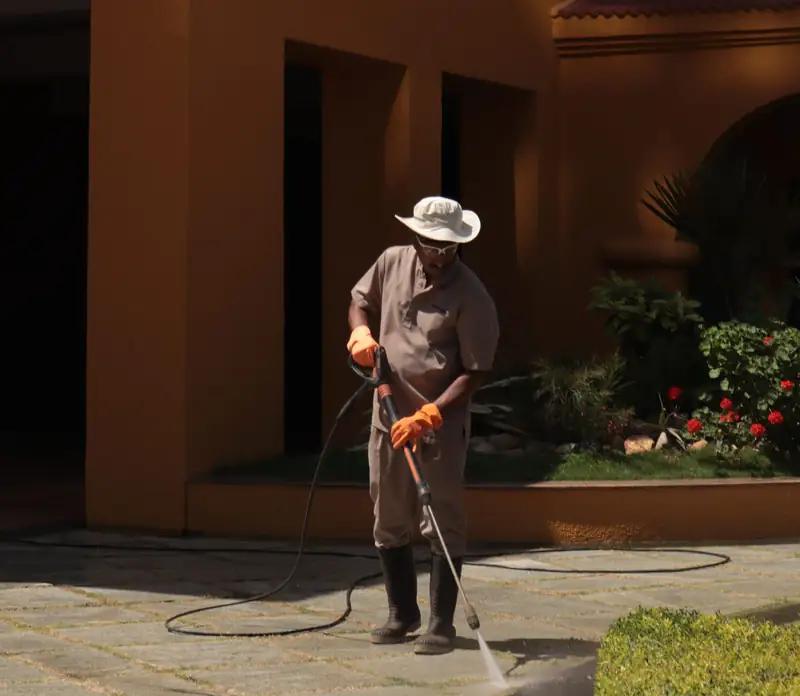
For routine staining, yes, with the same technique that applies to any paver cleaning: the wand held at an angle rather than straight down into a joint, since direct pressure into a joint strips out sand along with the growth it's meant to remove. A cleaner formulated for the surface, rather than a straight, undiluted bleach application, is worth using on stamped or colored concrete and on natural stone like travertine, since a harsh, concentrated chemical can dull a finish or lighten a color faster than the organic staining itself would. our guide to cleaning pavers without ruining the joints or sealer goes through the technique in more detail.
Frequently asked questions
What's the difference between mold and algae on pavers?
Mold and mildew are fungi that feed on organic debris in shaded, damp spots and tend to read as a darker, almost black film. Algae is plant-like, needs light as well as moisture, and shows up more often as a green or slick coating in sunnier wet spots, a pool deck's edge being the common example. A stained surface often carries both at once, and the cleaning approach is similar either way.
Why does only part of my patio get moldy while the rest stays clean?
Localized staining almost always tracks a localized moisture or shade difference: a section under a tree canopy, near a downspout, or shadowed by a screen enclosure for most of the day stays damp far longer than an open, sun-exposed section a few feet away. Matching the stained area to what's different about its shade or water exposure usually points straight to the cause.
Will sealing my pavers stop mold and algae from coming back for good?
Sealing helps at the margins, since a sealed surface sheds water a little faster and gives organic growth less to grip onto, but it isn't a permanent fix on its own. A shaded, poorly draining spot will still grow mold or algae again eventually under a sealer coat if the shade and drainage that caused it in the first place never change.
Can mold or algae make a pool deck slippery or unsafe?
Yes, a slick algae film in particular can make a wet pool deck noticeably more slippery underfoot than the same surface clean, which matters more right at the coping where people are walking in and out of the water barefoot. Our guide to making a slippery pool deck safer covers texture and traction options beyond routine cleaning.